

Chinese Battery Companies Going Global: A Country Smaller than Zhejiang Becomes the World’s No.2 Power Battery Nation
Date : 2023-07-01
30 June 2023 22:29 FIAN
I’m a journalist for the Book of the Book.
As soon as the Ning Kings do it, a city or even a country’s battery industry will never exist.
China is the world ‘ s largest producer of power cells, and where is the second future?
What is surprising to many is that it is not Germany nor the United States, but the Central European State of Hungary.
The population of Hungary is less than 10 million, which corresponds to the size of second-line cities in China; it covers an area of 93,000 square kilometres, which is slightly smaller than the province of Zhejiang (10.18 million square kilometres) in China.
Automobiles are the backbone of Hungary ‘ s economy, where Mercedes, BMW and Odie have electric car operations, and where Chinese battery enterprises, which are suppliers of batteries, have settled locally.
At the World Power Batteries Conference held on 9 June in Huebin, the Hungarian Minister for Foreign Affairs and External Economy, SZIJÁRTÓ Péter, said that, thanks to a series of investments by Chinese enterprises, Hungary now ranked fourth in production, rising to the second highest in the world after China.
June 8, China Battery EnterpriseBillion latitude lithium energy.(60.500, 3.26, 5.70%30014.SZ) announced the construction of a plant in the city of Debresen, Hungary, with an investment of €1.310 billion (approximately MOP 9.97 billion). Billion-latitude lithium will produce large cylinder batteries in Hungarian factories, providing near-range BMW vehicles.
A year ago,The Ningde era.(228.790, 6.29, 2.83%(300,750.SZ) was the largest investment project ever made for Hungary. In August 2022, the Nind era announced the phased construction of a battery plant in the city of Debreson, with a total investment of not more than Euro7.34 billion (approximately RMB 56.370 billion) and a planned gross production capacity of 100 GWh for customers such as Mercedes, BMW and the public.
Thanks to investment by Chinese battery companies, China is expected to be the largest source of investment in Hungary again in 2023. The city of Debresen, with a population of less than 200,000, has also become the Hungarian and even European power cell industry.
Now the world’s fourth and up to the second.
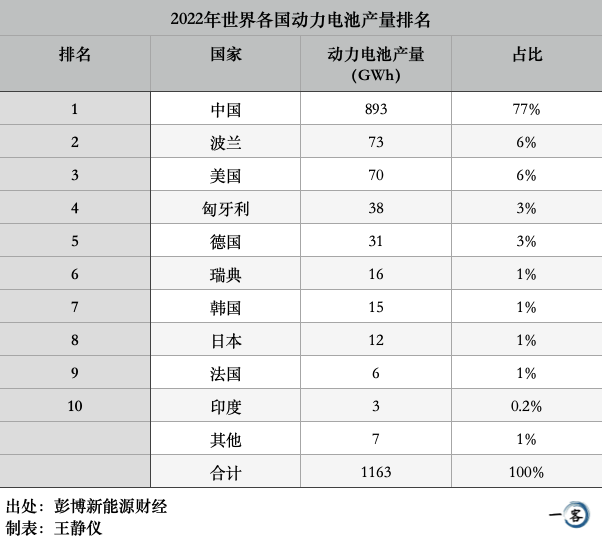
According to Bloomberg’s new energy finance data, in 2022 China ranked first in the world, 893 GWh, or 77 per cent; Poland and the United States ranked second and third, producing 73 and 70 GWh batteries, each accounting for 6 per cent; and Hungary ranked fourth, 38 Gwh, with 3 per cent of global capacity.
Why Hungary? It is mainly driven by the electric transformation of multinational and, in particular, German automobile companies.
Both Mercedes and BMW built electric automobile factories in Hungary, and Audi started electric power production at the Hungarian plant. “There are only three countries in the world, Hungary, China and Germany, with three of the world’s three luxurious brands of manufacturing.” Siyar, too.
In order to meet the procurement needs of transnational vehicles, Chinese battery suppliers, as suppliers, have come to build plants.
The largest was the Ningde era. In 2022, the Nind era announced the construction of the second European battery plant in Hungary, capable of producing 100 GWh, seven times more than the first battery plant (14 GWh) in Germany, which will create 9,000 new jobs locally for customers such as Mercedes, BMW and the public.
In the Nind era, Hungary has three advantages: first, Hungary has a long history of the automobile manufacturing industry, a well-organized industry and a wealth of raw materials in the surrounding area; secondly, Hungary is located in the heart of Europe, with a strong regional advantage, bringing together a large number of whole-car enterprises to build locally and to enable it to respond in a timely manner to client needs; and thirdly, Hungary, particularly in the city of Debresen, has an excellent investment climate with good infrastructure and a good pool of talent.
Billion-latitude lithium can also be located in Debresen, Hungary, where, in June 2023, 100 million-latitude lithium can announce an investment of 1.31 billion euros (approximately 9.97 billion yuan renminbi) to produce large cylinder batteries for BMW supply.。
Before that,Eun Jian shares(96.350, -2.15, -2.18%(002812.SZ) In 2021, investments were made in the construction of a lithium cell diaphragm production base in Debresen, Hungary, at a cost of Euro340 million, and pre-natal preparation is under way; in 2022, the first overseas plant in Hungary, the European manufacturing centre, the service centre and the research and development centre for utilising products, is also located in Debreson.
Due to the number of ongoing projects, Sijardo claims that Hungarian power cell production is now ranked fourth in the world, and that all investment projects will be completed and will be ranked second in the world.
It is not hard to see that these investments have all come together in one place — Debreson. With a population of only 200,000 people, not well known to most Chinese, the Ningde era and the arrival of two major batteries, Lithium Lithium Energy, have attracted upstream supply chain firms and have already seen a clustering effect in the battery industry.
In the near future, Sidardo has revealed that another top 10 power battery company in the world will announce an investment plan for Hungary to create a large European battery production cluster to supply car batteries to Europe as a whole and to the world.
China Battery Enterprise, Hungary’s largest source of foreign investment
In the past year and a half, power batteries were Hungary ‘ s largest export, helping to climb Hungary ‘ s exports to 34th place in the world in 2022. Hungary ranks 95th in the world population.
“The electric automobile industry is the real crossroads of the East-West economy. The major Western automobile manufacturers will soon shift their focus to electric cars, and the current major battery producers are China and South Korea, which also proves from the side that Hungary is a good interface for the East-West economy.
Hungary has taken on a series of large-scale investments in Chinese battery enterprises, not without a policy environment.
In recent years, China and Hungary have had close political and economic relations, which have been rated “the best in history”. In 2015, Hungary was the first European country to join the “One Way Forward” initiative.
Hungary officially launched the “Open to the East” policy in 2011, when the then Prime Minister of Hungary argued that the World Centre for Economic Growth was moving towards Asian countries, and Hungary therefore looked to East Asian countries to attract Asian enterprises through lower tax rates and a favourable investment climate.
According to Sialdo, a series of large investments from China demonstrates the success of Hungary’s “open to the east” policy.
In 2020, for the first time, China became the largest source of foreign investment in Hungary, benefiting from investment in Chinese battery enterprises, and in 2023 it is expected that it will again become the largest source of investment in Hungary.
Hungary is the country that has benefited the most from the “one way forward” initiative. According to the Investment Report of the China “One Zone” Initiative for 2022, published by the University of Jordan, the main beneficiaries of Chinese investment were Hungary ($7.6 billion), Saudi Arabia ($5.6 billion) and Singapore ($2.5 billion), with the “one Zone” initiative growing most rapidly in Hungary (623 per cent), Malaysia (877 per cent) and the Philippines (578 per cent).
According to the China Daily,Biadi.(258.270, 2.57, 1.01%♪ Come on, come on, come on ♪China Communications(45.540, 0.36, 0.80%Other large Chinese enterprises have established regional headquarters for Central and Eastern Europe in Hungary.
Out of Europe, there are opportunities and challenges.
With the exception of Hungary, Chinese battery manufacturers have extensive maps in Europe.
The Head of the European Battery Union, Tore Seknis, at the World Power Battery Congress on 9 June, said that many of the new battery capacity in Europe came from Chinese companies, and that the Chinese Battery Enterprise project, which is now operational and operational, had a vision of energy and the Ningde era, and that the Chinese company that announced its investment plan had beehive energy, Chinese innovation voyages, and billions of latitude lithium energy.
China Battery Manufacturers help to build fast up battery capacity in Europe. Torre Seknis quoted data indicating that in 2012 battery capacity in Europe was less than 1 GWh and that currently 80 GWh. By 2025 and 2030, European indigenous battery capacity will reach 458 GWh and 1083 GWh, respectively.
The European battery capacity is not yet sufficient to meet market demand, with a projected demand of 550 GWh in 2025 and a demand of 1,000 GWh in 2030, and a demand-supply balance is expected to be achieved by 2030.
Torre Seknis noted that there were short plates in Europe for raw materials and skilled workers, battery-related machinery and equipment. Europe is estimated to lack 800,000 skilled workers by 2025, with higher costs for energy, land and licences, and only 1 per cent of the European mainland production of critical battery raw materials.
More importantly, in the last two years, Europe has adopted a series of regulatory acts that seek to build indigenous chains in the battery industry, and conservation policies have had some impact on the market openings of Chinese battery companies.
The impact of the Battery and Waste Battery Regulations and the Key Raw Materials Act is greater, requiring that the indigenous extraction of critical raw materials reach 10 per cent by 2030, that the indigenous processing of raw materials reach at least 40 per cent, that the local recovery rate is at least 15 per cent and that the reliance of critical raw materials on a single third country is not more than 65 per cent; and that battery enterprises are required to keep up to the supply chain for essential raw materials and that battery enterprises above the carbon footprint limit are prohibited from entering Europe.
In order to meet the needs of motorists, Chinese battery manufacturers are moving quickly out of the sea to build their plants, and challenges remain in all areas to cross to achieve real outreach and international leadership.