

Important Progress in CO2 Electrocatalytic Conversion at Shanghai Advanced Research Institute
Date : 2023-06-08
Time:2022-11-10
In recent days, Wei Wei and Chen of the Shanghai Institute of Advanced Studies have designed a carbon-neutral fibre-transmitting electrode for the team of researchers, providing an unlimited amount of CO2 to the three interface active bits.2Breaking low CO2Solvent-restrictive bottlenecks, resulting in the reduction of CO at the Amber-level current density2Generate multicarbon products. The results of the study are used as “Ampere-lever CO”2 “Reducation to multicarbon projects over a copper gas humanization online” in the flagship journal Energy Environmental Science & Environmental Science 2022, DoI: doi.org/10.1039/D2EE02121H) The first author of the paper was Zhu Xian, a doctoral student at the Shanghai Institute of Higher Studies of the Chinese Academy of Sciences, whose research was supported by funding from the Ministry of Science and Technology, the Ministry of Science and Technology, the Ministry of Science and Technology, the Ministry of Science and Technology, the Ministry of Science and Technology, the Ministry of Science and Technology, the Ministry of Science and Technology, the Ministry of Science and Technology, the Ministry of Science and Technology, the Ministry of Science and Technology, the Ministry of Science and Technology, the Ministry of Science and Technology, the Ministry of Science and Technology, and the Ministry of Science and Technology, the Ministry of Science and Technology, the Ministry of Science and Technology, the Ministry of Science and Technology, the Ministry of Science and Technology, the Ministry of Science and Technology, the Ministry of Science and Technology, the Ministry of Science and Technology, the Ministry of Science and Technology, and the Ministry of Science and Technology, the Ministry of Science and Technology, the Ministry of Science and Technology, and the Ministry of Science and Technology, the Ministry of Science and Technology, are among others.
CO driven by renewable electricity2Electrochemical conversion to value-added chemical fuel is reducing CO22There is a dual role for net emissions and energy needs. However, because of the slow dynamics of multiple proton-electronic coupling and C-C coupling steps, eCO2RR to C2+The current density of products remains insufficient for industrial scale implementation. Low CO2Solubility (only 34 mm below 25°C and 1 atm) and thick transfer boundary layers prevent CO2Passage, so developed at high current density C.2+The production of high-efficiency electrodes is of particular importance, and the design and development of new electrode configurations is the achievement of CO.2Important research directions for efficient conversion to high-value multiple carbon products.
The research team has long focused on electro-catalytic CO.2Conversion studies, a series of basic and applied studies, in alloys, nitrogen-blended carbon catalysts, electric catalytic CO2Good progress has been made in the efficient synthesis of high-value added oxygen-containing compounds and in the development of new IMEPs. Technical validation and engineering amplification at different scales is being carried out in cooperation with enterprises such as the Bowloon Group, Shin Energy Group and the National Energy Group to promote CO2The results of the ECR-related studies move from laboratory to practical applications as soon as possible and are expected to result in CO2-reducing engineering technologies with full autonomy and significant impact. (graphs/texts Zhu Chong, Chen)
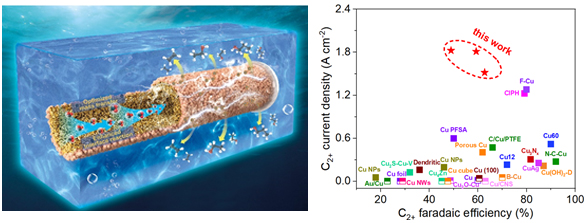
Figure 1. Electro-efficient reduction of the copper electrode in the middle fibre2Maps and electro-catalytics