

National Energy Administration Issues Notice on New Energy Storage Pilot Demonstration Work
Date : 2023-06-08
2023-06-16 17:58Source: National Energy Agency.
The Arctic Solar Energy Network was informed that on 16 June, the Integrated Division of the National Energy Agency released a report on the implementation of theNew types of storage capacityNotification of pilot demonstration work. With the aim of promoting the diversification and industrialization of new types of storage energy, the demonstration project was organized to select a range of new types of energy technologies with competitive potential in terms of safety and economics, in a typical application scenario.
The declared projects are, in principle, completed and are expected to be operational by the end of 2024.
The duration of the demonstration is in principle two years. Model projects are to be operational within one year of the date of the announcement. In exceptional cases, the demonstration period and the date of commissioning may be extended by no more than one year with the agreement of the National Energy Agency.
In principle, each recommended unit recommends no more than three projects, of which no more than two are on the same technical route.
The Central Enterprise Group could recommend demonstration projects directly to the National Energy Agency.
Details are as follows:
Notification from the Integrated Division of the National Energy Agency on the pilot demonstration of innovative storage capacities
The provincial (autonomous regions, municipalities directly under the Central Government), departmental (autonomous regions, municipalities directly under the Central Government) and Xinjiang Production Corps Development and Reform Commission, Industrial and Information Service, Municipal Administration Commissions, various agencies, central enterprises:
In order to follow up on the 20th and 20th Plenums of the Party, to implement seriously the requirements of the Fourteenth Five-Year Plan for Economic and Social Development of the People’s Republic of China and the Programme for the Implementation of the Vision 2035, the Programme for the Development of New Storage Capacities in the 14th Five-Year Plan, to accelerate the development of new types of reservoir energy diversification, industrialization and high-quality marketing, and to support the construction of new energy systems, the Bureau intends to organize a pilot demonstration of new types of storage energy and to develop the Model Operating Rules for the Piloting of New Storage Energy (Preliminary) (hereinafter referred to as the Rules, see annex 1). In order to conduct the selection process for the demonstration project, the following information is provided on the matter.
First, with the aim of promoting the diversification and industrialization of new types of storage capacities, the demonstration project was organized to select a range of new types of energy technologies with competitive potential in terms of security and economics, based on typical applications.
II. NEWEnergy projectThe owners are declared units, the energy authorities of the provinces (autonomous regions, municipalities directly under the Central Government) and the Xinjiang Production Corps, and the Central Enterprise Group.
3. Declaring units are requested to submit signed declarations to the provincial energy authority or to the central enterprise group to which the project is located by 13 July 2023, as required by the Rules.
The declared projects are, in principle, completed and are expected to be operational by the end of 2024. The project for disclosure of intellectual property rights is clear, technologically advanced and demonstration-led.
4. To request provincial energy authorities and the Central Enterprise Group to organize, conduct preliminary reviews and recommend model project declarations, taking into account the actual situation in the region and the enterprise. Please send the paper-based recommendation 1 to the Science and Technology Department of the National Energy Agency by 13 August 2023. At the same time, electronic material (web site:) is submitted through the new national storage capacity platform.
In principle, each recommended unit recommends no more than three projects, of which no more than two are on the same technical route.
5. The National Energy Agency will organize reviews to establish a short-listed list of demonstration projects and include a new national platform for large-scale storage of energy and a national inventory of major engineering projects to enhance follow-up assessment and dissemination.
Recommendations shall include written recommendations, relevant project declarations, supporting policy considerations, etc. For information, please use the Chinese postal EMS. The date of submission is based on postmarks.
Mail address: 46 San Ri River Road, Western District, Beijing, ed.: 100045
Contact: Science and Technology Division, National Energy Agency, 010-81929227/9226, 010-81929218 (fax)
Newer national storage capacity big data platform: wings 1881030218
Zhao Weiwei 1556555498.
Mailbox: nngxiaochuneng@nea.gov.cn
Annex
1. Model working rules for the pilot demonstration of innovative storage capacities (pilot)
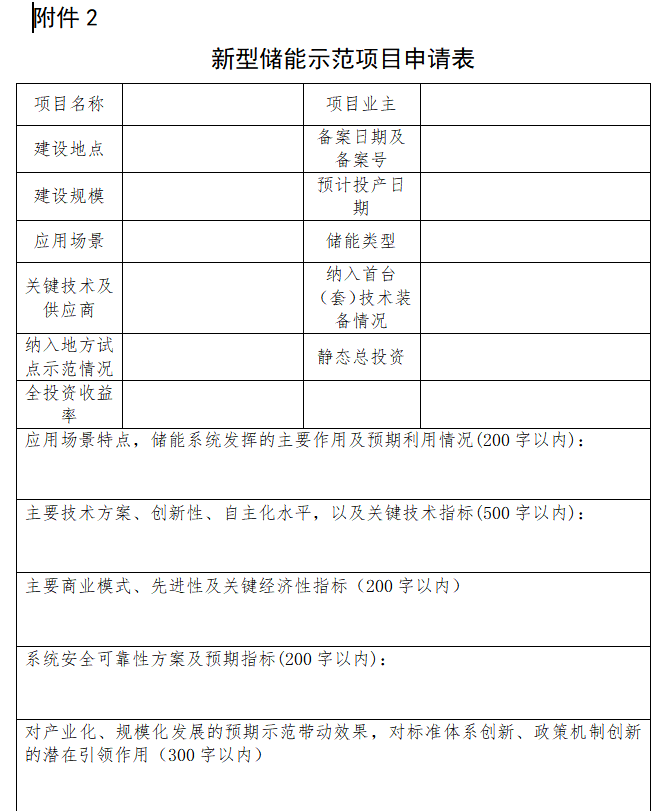
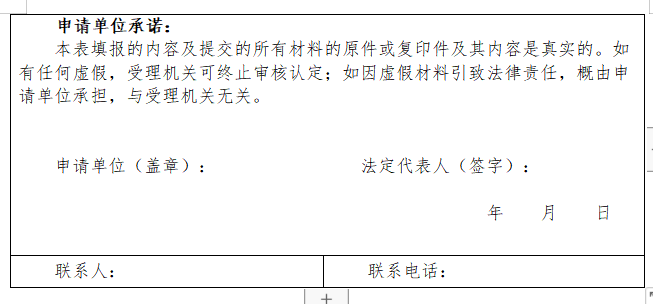
2. New model project application form for storage capacity
3. Report on applications for new model storage capacity projects (reference outline)
Integrated Division of the National Energy Agency
12 June 2023
Annex 1
Model operating rules for new types of storage capacity pilot (pilot)
In accordance with the Fourteenth Five-Year Plan for Economic and Social Development of the People’s Republic of China and the Vision 2035 Programme for the Implementation of the “1455” New types of storage energy development, the first is to promote the diversification, industrialization and high-quality market development of new types of storage energy.
The second rule applies to the pilot demonstration of new energy storage technologies and applications organized by the National Energy Agency. The provincial energy authorities have advanced the pilot demonstration of new storage capacities in the region, which could be organized in the light of these rules, taking into account local conditions.
New types of energy storage projects referred to in this third rule are those in which, in addition to pumping capacity, the primary form of output of electricity and the provision of external services.
The fourth model project declaration, selection and follow-up evaluation should adhere to the principles of government direction, corporate voluntarism, diversified development, priority breakthroughs, demonstration-led, scale-based development, scientific evaluation and results-oriented evaluation.
The subject of the fifth model project declaration is in principle the owner of the project. Where a joint declaration is required, the need and the specific division of labour should be stated. The entities participating in the declaration shall be enterprises registered in the territory of the People ‘ s Republic of China that have an independent legal personality and have no adverse credit records and have greater economic power, technological research and development and the ability to integrate innovation.
Article 6 declaration projects should be characterized by technological sophistication, innovative business models, safety reliability, representation of applications, and demonstration drive.
The Article 7 model project workflow consists mainly of six links: publication of notifications, organizational declarations, expert review, review of decision-making, public announcements, summary promotion.
(i) Publication of notices
The National Energy Agency publishes circulars on the official website, initiates the declaration process and specifies specific requirements for demonstration project declarations.
(ii) Organizational declarations
Provincial energy authorities should organize model project declarations, preliminary clearances, recommendations, etc., taking into account the actual situation in the region, and issue written recommendations. A written letter of support from the central enterprise group shall be attached to a declaration made by the respective provincial energy authority.
The Central Enterprise Group could recommend demonstration projects directly to the National Energy Agency.
(iii) Expert review
The National Energy Agency has commissioned a pilot project evaluation process from a third-party agency. The information is reviewed at first instance and by expert review, resulting in a written evaluation and submitted to the National Energy Agency. Organization of corporate representation or field visits, as required.
Model project review experts require high-level and above-grade titles and have not less than four years of technical work in related areas. The evaluation experts will cover the professional orientation of the project under review, with no fewer than seven experts. The evaluation expert shall not have an economic interest in the unit (including the joint unit) that will declare the project under review.
(iv) Consideration of decision-making
On the basis of a review by a third-party body, the National Energy Agency examines the establishment of a shortlist of demonstration projects, taking into account relevant documentation requirements such as industry planning and industrial policy.
(v) Publicity
The National Energy Agency publishes a short list of model projects on the official website, which is published for a period of not less than seven days. Upon completion of the announcement, the National Energy Agency publishes a list of model projects in the form of an announcement.
(vi) Summary outreach
During and after the demonstration period, the National Energy Agency commissioned a third-party evaluation of the impact of the demonstration applications to scale up lessons learned and outreach on advanced and promising technology and business models in demonstration projects, standard norms and policy initiatives that have produced better results at the local level.
The model duration of Article 8 is in principle two years. Model projects are to be operational within one year of the date of the announcement. In exceptional cases, the demonstration period and the date of commissioning may be extended by no more than one year with the agreement of the National Energy Agency.
The National Energy Authority for Article 9 has integrated demonstration projects into the National New Energy Large Data Platform, conducted monitoring of the operation of demonstration project construction and conducted a summary of the evaluation of project implementation. Provincial energy authorities need to strengthen demonstration project management, coordinate solutions to project problems, improve new systems of energy management and support policies.
The tenth declaration unit is required to comply with the new system of project management for energy storage, obtain procedures for project construction, network operation, etc., in accordance with the procedure, and to advance the demonstration project construction, enhance system operation maintenance and report promptly to the National Energy Agency on the operation and standardization of project construction.
Article 11 of the National Energy Agency (NEA) has sent agencies to strengthen the monitoring of the implementation of demonstration projects in the context of integrated monitoring of work arrangements, to coordinate with local energy authorities to address problems encountered in the implementation of demonstration projects and to report the results to the NEA.
Article 12 disallows model projects where the reported information is false, is not built in accordance with the model, there is a major security liability incident or other violation of the model requirements.
Article 13 of the National Energy Agency coordinated the resolution of major problems faced by demonstration projects, including through the integration of demonstration projects into national databases of relevant major engineering projects. Support for major technical equipment that meets the first set of requirements, based on the relevant criteria resulting from the demonstration project, is assessed in accordance with the procedure, priority is given to the industry standard revision plan, the first list of major technical equipment in the energy sector, priority is given to the selection of incentives for science, technology, innovation, standards, etc., and support policies.
The energy authorities of the Article XIV regions, together with interested parties, have stepped up their policy research and support for demonstration projects in terms of project costing, movement control, safety management, etc., and have encouraged support for demonstration projects through policies such as specific funding. Local energy authorities need to combine national and regional pilot demonstration of new storage capacities and play a leading role in the development of new ones.
Article 15, this rule, is interpreted by the National Energy Agency.
This rule in article 16 applies from the date of its publication.
Annex 3
Report on applications for new model storage capacity projects (reference outline)
I. Project overview
Project overview, background and need analysis of construction, as well as progress of previous work, such as technology R & D validation, engineering construction, investment decision making in the enterprise ‘ s project, and access to sectoral approvals such as planning, land, environmental protection, etc.
The project owner ‘ s investment, main business and lifetime, experience in the operation of new types of energy project construction, innovative inputs related to new types of energy and standardized work performance, and qualifications.
II. Preliminary programme of the project
(i) Application of scenes and expected mode of operation
Describe the characteristics of the application scene. The primary role played by the storage energy system, the mode of operation of the movement control system and the expected utilization indicators, such as utilization, efficiency, etc.
(ii) Technical programmes
Description of the basic components of the project ‘ s energy storage system, key technologies, equipment and systems. Innovative integration of technology products and systems is illustrated through a comparative analysis of key indicators of similar technical equipment in the country and abroad.
A description of the project ‘ s use of autonomous original intellectual property technologies and the status of intellectual property ownership.
A description of the status of inclusion of the first major technical equipment set in the inventory, as well as the eligibility for recommendation to the first major technical equipment set in the energy field.
(iii) Engineering programme
Description of project construction conditions, scope of construction, placement modalities, access programmes, schedule, etc.
(iv) Model project operational programme
For project applications, describe how the project operates, how the movement is carried out, and analyse indicators such as annual power, hours of operation, etc. exchanged with the system, and the match between project and scenario applications.
(v) Standardized work programme
Description of participation in the revision of national, industry, group and local standards based on the model project.
III. Economic aspects of the project
A description of the main business models and their sophistication, and a brief analysis of future prospects for replication.
Describe the border conditions associated with economic evaluation, such as access to local government-related support policies, including, but not limited to, project-based electricity policies, fiscal subsidies, tax incentives, power support services and mechanisms for off-site market construction.
Description of engineering investments, such as those for the storage system and total project investments, investment recovery periods, internal rates of return, etc., and expected operational cost returns for the first year of production and the year of delivery.
IV. Project quality and security
Brief description of the project ‘ s quality and safety control programme, its sophistication and key indicators.
Project work plan
The project begins and ends, the expected date of commissioning and the organization of work on an annual basis.
VI. Integrated benefit evaluation
(i) Model effects
The demonstration project, while demonstrating the steady and reliable operation of key technologies, was instrumental in promoting clean energy development, supporting the operation of power systems, improving efficiency in energy use, reducing the cost of energy use and ensuring energy security, as well as contributing to the development of industrial chain systems, sound policy mechanisms and the development of specialized personnel. Brief analysis of the prospects for replication of innovations in key technologies, business models, application scenarios, etc.
(ii) Environmental benefits
Analyse and evaluate the impact of project construction on the promotion of natural ecological development.
(iii) Social benefits
To analyse and evaluate the real and long-term impact of project construction on the promotion of economic and social development in industry and local communities.
Risk assessment and response initiatives
Analysis of the potential risks of demonstration projects in terms of policies, environment, markets, economy, technology, construction, etc., and recommendations for response measures or other pilot demonstration exercises.
Appendix
Proof has been obtained of the approval of the planning, land, environmental protection and other supporting materials that need to be submitted.