

Prof. Liu Yong’s Team Publishes Latest Electrocatalysis Research in Nature Communications
Date : 2023-06-08
Issue: 2023-03-23 17:36 Source: Model Academy for the Internationalization of Materials Science and Engineering
NewsWeb In recent days, our team of Professor Yong Liu of the Model Institute for the Internationalization of Materials Science and Engineering (IAE) has made a major breakthrough in the design research of the Aerobic Remittance Power Catalyst Catalyst of the Fuel Cell, which resulted in the publication “Mesoporous Pt@Pt-skin Pt3Ni core-shell kermework nanowir electronics for efficient oxygen review” online on 18 March, in Nature Communications (Nat. Commun. 2023, 14, 1518), a sub-author of the top international journal Nature. This is also a major development for the group of Professor Liu Yong following the publication last year of monolithic PV material for the opposite sex in the leading journal in the field of international materials, Advanced Materials (Adv. Mater. 2022, 2204342).
The development of high-performance catalytic materials for new energy systems is key to the implementation of the “two carbon” strategic objective. Fuel cell technology is a preferred option for addressing future sustainable new energy supplies, especially in the area of electric cars. The oxygen reduction response (ORR) is the core response of new energy technologies for fuel cells and the key to their commercialization. However, the usual ORR reaction catalysts are precious metals, of which platinum (Pt) is currently the most widely recognized electrochemical catalyst for ORR performance. However, Pt ‘ s low level of storage and high cost in the earth ‘ s crust has hampered its large-scale applications in the fuel cell sector. Improving the atomic utilization, responsiveness and stability of Pt catalysts has been central to the development of energy technologies such as fuel cells.
Currently, material chemists are mainly managing the microstructures and chemical components of catalysts to increase the utilization and catalytic performance of Pt and other cheap metals (e.g. Ni, Fe, etc.) in more than 3D (3D). Hole-frame structure is a promising approach. This method not only significantly reduces the content of the Pt in the catalyst, but also maximizes exposure to high activity levels. In addition, the one-dimensional (1D) nanostructure is considered to be the most effective way to improve the stability of the Pt catalyst because of its inherent orientation heterogeneity, high conductivity and greater surface contact with the carbon carrier. Theoretically, therefore, if Pt-based catalysts could be designed in a combination of the 3D D-Dokonami framework and 1D-Nam heterometry, they would not only maximize the atom utilization of the Pt-based catalysts, but would greatly improve the activity and stability of the Pt-based catalysts, thereby obtaining the best-performing ORR catalysts.
To this end, the team of Prof. Liu Yong of Wuhan Polytechnic University has recently designed to synthesize an all-dimensional heterogeneity hole Pt@Pt-skin Pt3Ni Nuclear-shell Frame Nanoline (CSFWs) efficient electrical catalysts. The catalyst is constructed of a 1-dimensional super fine Ptnm line (~3 nm) and a Cascading Pt-skin Pt3Ni frame nuclear-hull heterogeneity with excellent electro-catalytic activity, stability and high Pt atomic utilization. In the ORR catalytic response, the catalyst ‘ s mass activity (MA) and activity (SA) was as high as 6.69A/mgptand 8.42mA/cm2This is 29 and 26 times, respectively, of the commercial Ptnaker; the catalyst also shows excellent stability, with its active decay of less than 3 per cent after 50,000 cycles.
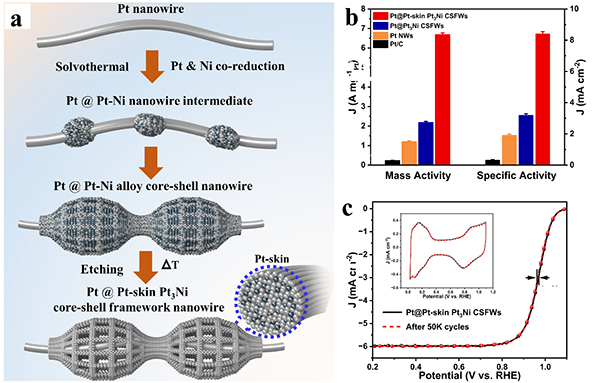
Quakers Pt@Pt-skin Pt3Ni Nuclear-shell Frame Nanoline (CSFWs) tabulation and performance Figure
The pore Pt@Pt-skin Pt3Ni nuclear-shell frame nanolines combine the three-dimensional open-pore structure and the advantages of one-dimensional heterogeneity and effectively address the bottlenecks of Pt-based catalysts in the cathode oxygen reduction reaction (ORR) of fuel cells. This work has been supported by the platform of the Vuhanjian Polytechnic University ‘ s Laboratory of Life Complex Materials, the team of Prof. Marykian of Wuhan Polytechnic University and the team of the Zhao Dong Councillors of the University of Jordan, with funding from major projects and projects of the National Fund for Natural Science and the initial funding of research at Wuhan Polytechnic University.
Liu Yong, Professor at Wuhan Polytechnic University, Ph.D. student mentor, senior youth talent at the provincial ministry. Received a doctorate in science from the University of Jo Dong in 2015 and then conducted post-doctoral research at Jo Dong University (2015-2016), University of California Berkeley (2016-2019 and Yang Pee Dong). Returned to the Wuhan Polytechnic University Institute for the Internationalization of Materials Science and Engineering in 2020, mainly for the controlled synthesis of new functional semiconductor microelectronics/porous materials, interface self-assembly assembly and their conversion and storage in new energy sourcesInnovative applied research in areas such as storage.