

USTC Makes New Progress in Electrocatalytic Neutral Water Oxidation
Date : 2023-06-08
Source: Ministry of Scientific Research
Hydrogen is considered a very green and clean energy source. The main current hydrolysis methods include alkaline hydrolytic hydrogen and acid hydrolytic hydrogen, although the process requires the use of corrosive solutions as electrolyte, with more stringent requirements for catalysts and concentrates. There are therefore important applications prospects for the development of catalysts with superior activity under neutral electrolyte conditions. OER, however, has a very slow kinetic process under neutral electrolyte conditions, which makes it less active. ABO3The oscillates, as a category of OER catalyst material, received extensive attention from researchers. Traditional solid, counterproductive catalysts for argon, due to their low surface size, limit exposure to more active bits. Thus, the development of an effective synthesis method for the preparation of high-prevalence mineral ore material is a prerequisite for enhancing the catalytic activity of OER.
In recent days, the Chinese University of Science and Technology team of Zhou Shu Shui Hong has developed a common synthesis method for nano-pipes with high surface area oxidation, which has resulted in the development of up to 13 suitable materials for oxidation. Scanning the catalytic activity of a series of platinum minerals under neutral electrolytic fluids led to the discovery of Sm mixed LaCoO.3Catalysts have the best OER activity and have established metallic-oxyxic co-price strength as an effective neutral electro-catalyst of OER ‘ s active description. The results of the study, entitled “General Synthesis of Tube-like Nanostructued Perovskie Options with Tunable Transmission Metal-Oxygen Covalency for Economic Water Establishment in Natural Media”, were recently published in the American Chemical Convention.J. Am. Chem. Soc.The Panel finds that the claim is for loss of tangible property. The co-authors of the paper were Dr. Yu Yu, Dr. Dianyu and Dr. Koongen.
Using carbon-covered nanolines as templates, researchers synthesized LaCoO with porous structures through hydrothermal processes and subsequent defusing treatment3Nano-pipe materials (figure 1). Further to LaCoO3The mixing of A points (A points include Ce, Pr, Nd, Sm or Gd), B points (B points include Mn, Fe, Ni, Cu or Zn) and A/B points are mixed (A/B points include Pr/Ni or Sm/Ni), resulting in the universal synthesis of up to 13 oxidating nanomaterials. A series of titanium oxide nanomaterials with high BET surface area of 30~48 m2/g, much larger than aluminum material 6 m2/g) and most of the literature reported mining materials. The homogeneity of elements is determined by multiple manifestations. State density calculations show that mixing can lead to LaCoO.3Changes in electronic structures help to regulate the adsorption of the OER process to the reaction intermediate.
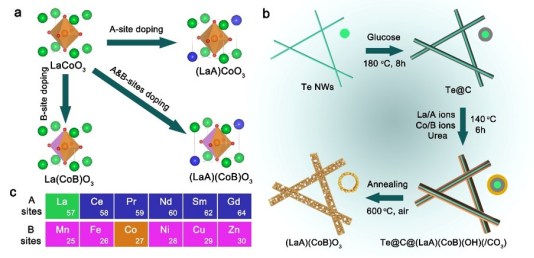
Figure 1. A map of the generic synthesis of nanoparticle materials in the series of oscillates.
OER tests under neutral electrolyte (1 M PBS, pH 7) show that Sm-LaCoO3Catalysts have the largest oER current density and the smallest excess. It’s in 10 macm-2Only 530 mV excess power required at current density, better than Ni-LaCoO3Catalyst (582 MV), Sm/Ni-LaCoO3Catalyst (579 mV) and commercial Ruo2Catalyst (608 mV). In order to exclude the impact of the surface area, the conversion of the oER visual activity to the oER activity can truly reflect the nature of the catalyst activity. The results show that Sm-LaCoO3Catalysts remain the most dynamic. At 1.75 V voltage, Sm-LaCoO3The ratio is 0.078 mmc.-2Electricity, Ni-LaCoO, respectively3、Sm/Ni-LaCoO3、LaCoO3, shape LaCoO3And Ruo.21.5, 1.6, 3.5, 5.2 and 1.6 times the catalyst. In order to explore the origins of different OER activities as catalysts, researchers have studied B-O co-priced keys for different argon materials (figure 2a). As a result, it was found that the neutral OER activity of the nanoplywood material series of quarries was associated with the volcanic map of the B-O co-priced key of the material, thus establishing metallic-oxycovalent co-price strength as a valid neutral electro-catalyst of OER (figure 2b). Sm-LaCoO at the top of the volcano map3Catalyst, with a B-O co-priced key that is neither strong nor weak, shows the best OER activity. Further DFT calculations show Sm-LaCoO3Catalysts have the lowest theoretical OER excess (figure 2c).
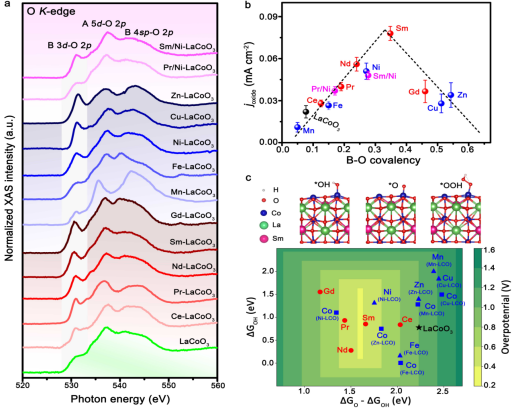
Figure2.(a) XAS-K border curve of oxygen from a series of quarries; (b) B-O co-price key in relation to OER active volcanic maps; (c) DFT theoretical calculations.
The study established a new methodology for the preparation of materials for high-scale surface area oscillating oxides, and established an effective neutral OER activity description symbol, which provides fresh thinking for a more efficient design of future neutral OER catalysts.
The research was funded by the National Priority Research and Development Programme, the National Fund for Natural Sciences, the Anhui Ministry of Science and Technology, and the Anhui Provincial Higher College of Innovation.
Articles Link:https://pubs.acs.org/doi/10.1021/jacs.2c02989