

Xi’an Jiaotong University Du Xianfeng Team in Nano Energy: Bottom Growth Strategy for High Areal Capacity Rechargeable Aluminum Batteries
Date : 2023-07-01
In recent years, global energy systems have been transformed from fossil energy to renewable energy, and energy storage is key to renewable energy use. Energy storage can be achieved in a variety of ways, and cells that store energy by electrochemical means are the most efficient and capable of large-scale application. Aluminium Batteries (Aluminium Batteries)AIBBecause of their low cost, high theoretical capacity (theoretically, volume and quality)8048 mAh·cm-3and2981 mAh·g-1) and high safety (non-combustion of water and air). However, due to uncontrolled surface patterns, chemical reactions and hydrodynamic processes of metal anode cells during charging, the growth of the crystals is inevitable. A recent study shows that:3DMetallic anodes can increase the area of effective exposure between electrodes and electrolytes and reduce the local current density of electrodes, thus preventing the erosion of the surface of electrodes and the growth of branches. However, due to high field strength and short ion diffusion pathways, metal particles still tend to be deposited in priority areas at the top of the electrodes. For aluminium battery systems with large surface capacity, the deposition of aluminium in a unit area is inevitably increased. Large amounts of aluminium sediments can build bridges between positive and negative electrodes, increasing the crystal growth, which will seriously undermine the long-term stability and safety of batteries.
In response to this problem, the team of Professor Doo-Shin of the Siam Chai Chemical Institute proposed an aluminum cell anode structure for the bottom growth pattern.2P-Al2O3/AlThe anode, which provides reverse field strength.Ebottom>EtopTo induceAlThe directed sediment. Even in large areas, stable electrodes can be formed.–The electrolyte interface. And the traditional plane.AlThis is not the case.2P-Al2O3/AlThe anode structure has the following key advantages:1)2P-Al2O3/AlThe anodes re-disperse the electrodes, induce.AlPriority deposition at the bottom of the electrode increases the safety distance between the diaphragm and sediment;2) It’s bigger than the surface.Al(a) Nuclear location, which would help to reduce to a nuclear base;3)3DThe electrodes are down.AlThe electrode inflation problem during deposition.2P-Al2O3/AlThe anodes have more stable electrodes.–Electrolyte interface and longer cycle life. Even5 mAh·cm-2It still works on a continuous basis.1200More than an hour. It’s a flat aluminum anode.6More than that. The strategy and methodology are of great relevance for the assembly of aluminium batteries with high energy density and high cyclic stability.
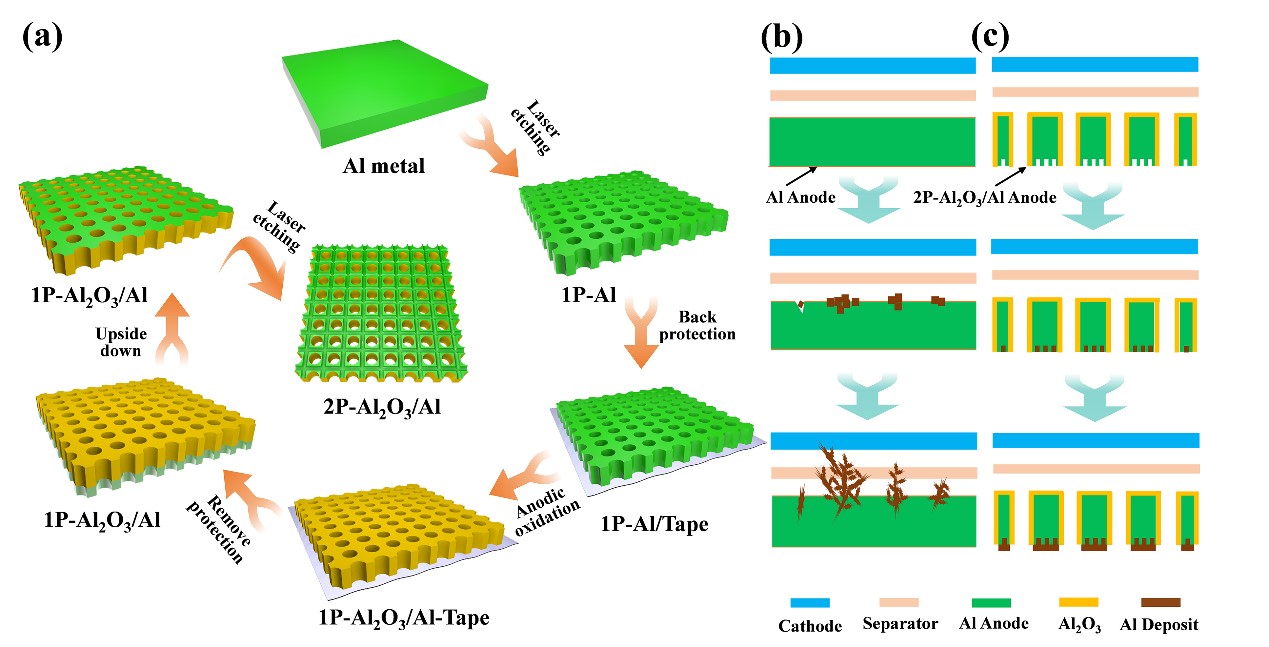
In recent days, the results of the study are entitledBottom Growth Strategy for High Areal Capacity Rechargeable Aluminum Batteries Published in the top international journal.Nano Energy(Nanoenergy)19.1)。The first author of the paper was Wang Xin, a doctorate graduate at the Siam Chai Chemical Institute, and the author of the newsletter was Professor Du Shih Spei and Associate Professor of Bear Loilong. The University is the only communications unit. The study is another study carried out by a group of professors in the field of aluminium batteries at the Faculty of Chemistry of the University of Transport in Sian, and is supported by the National Fund for Nature Sciences and the priority projects of the Natural Sciences Fund of Shaanxi Province. Professor Du Visible of the West Anthropology College of Chemistry has a long history of studies on electrolytic capacitors, lithium (sodium) ion batteries, aluminium ion batteries, supercapacitors, softly worn electrode materials for sensors, electrolyte, solidification, softening, integration, etc. AlreadyAdv. Funct. Mater., Energy Storage Mater., J. Mater. Chem. A, Carbon, ACS Appl. Mater. Inter., Adv. Mater., Inorg. Chem. Front., J. Am. Ceram. Soc.Relevant research papers published in internationally renowned academic journals and international conferences60The rest, patenting inventions. Near50item.
Articles Link:
https://www.sciencedirect.com/science/article/pii/S2211285523004639
Homepage of Professor Doo Hyeok-seong:
http://gr.xjtu.edu.cn/web/xianfengdu
Approving officer: Doo-Shin