

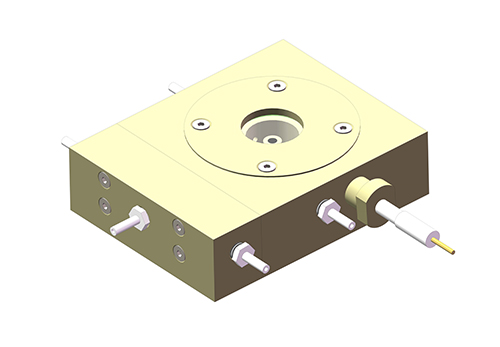
Electrocatalysis Raman Cell
Conventional electrochemical research methods use telecommunications as an incentive and detection tool, which provides a sum of micro-information about the electrochemical system, makes it difficult to identify accurately the reactions, intermediates and products of complex systems and to explain the electrochemical response mechanisms. In recent years, spectral electrochemical techniques, which combine spectral and conventional electrochemical methods, have become an indispensable means of field displaying and studying electrochemical systems at molecular levels.
In the electrochemical method of the in situ spectra, the electrochemical in situ Raman spectra technology can easily provide microstructure information for the electrodes surface molecule.
Electrochemical in situ Raman spectrometry is a dispersing phenomenon that uses the frequency of material molecules to make significant changes in the input light, and it stimulates the electrode surface subject to electrodes (including round oscillation and ray oscillation), by measuring the variability of the raman spectrometry signal (frequency, strength and oscillation) returned from the dispersion to the electropolar level or current strength. The Raman spectrum of the general material molecule is very weak, and in order to get an enhanced signal, the electrodes surface can be coarsed, and it can be enhanced with 104-107 times the strength of the surface by the Surface Enhanced Raman Scattering, SERS, and when the molecules with the resonance of the Raman effect are adsorbed to the coarse electrodes, the surface enhances the resonance of the SERRS spectrum, which in turn enhances 102-103.
The electrochemical in situ Raman spectroscopy is measured primarily in the Raman spectrometer and in situ Electrochemical Raman pool. The Raman spectrometer consists of laser sources, collection systems, spectrometers and detection systems, which generally use energy-intensive, high-power-density lasers, a collection system consisting of lenses, and a spectrometer or trap-filtration filtration grid to filter out the Raleigh dispersion and dispersible light, and a spectrometric system employing an electrical multiplication detector, semiconductor array detector or multichannel charger. In-situ electrochemistry Raman ponds typically have working electrodes, auxiliary electrodes and reference electrodes, as well as ventilation units. In order to avoid corrosive solutions and gas erosion instruments, the Raman pool must be equipped with a sealing system for optical windows. Where experimental conditions permit, in order to avoid as much as possible the interference of the solvent signal, thin solutions (0.1-1 mm between the electrodes and the windows) should be used, which is important for the micro-Raman system, where too thick an optical window or the solution layer leads to photoroute changes in the microsystem, which reduces the efficiency of collecting surface Raman signals. The most common method of coarsening an electrochemical oxidation-reversion Cycle, ORC, which is generally used in situ or non-local ORC processing.
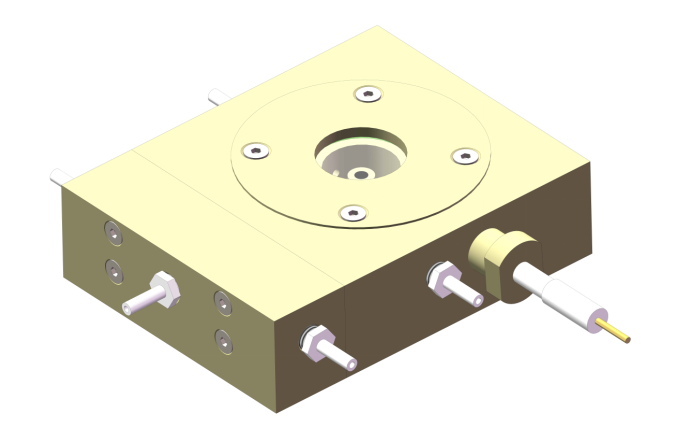
Main features:
(1) Type H, proton exchange film, separating WE from CE;
(2) Double chamber electrolyte is mobile;
(3) But the light